WeChat Official Account (微信公众号) Articles in 2026: Search, Full Text and Monitoring Without Login
TL;DR
- WeChat Official Accounts (微信公众号) are where Chinese companies, media and analysts publish long-form writing, but the content lives inside the WeChat app. There is no public search API. The practical way in is WeChat's public article search on Sogou (搜狗微信搜索), which works without a WeChat account or login.
- In a live run on Oct 26, 2026, four keywords (人工智能 AI, 新能源汽车 EVs, 跨境电商 cross-border e-commerce, 出海 going global) returned 120 articles from 115 different accounts in 46 seconds. Every row had a title, summary, account name, publish time and cover image.
- The results are fresh. For 人工智能, all 30 articles were published in the previous 4.3 hours. Across the three industry keywords, every article was under 14 hours old.
- Broad keywords mix in older "evergreen" pieces. For 出海, 10 of 30 results were more than a day old, 9 of them from 2019–2025 (36氪, 虎嗅, 南方周末 classics). A date filter skips those, and skipped rows are not billed.
- With full-article mode, 10 of 12 articles came back with full text (median 1,625 Chinese characters, 53 images in total). The other 2 had been removed by their authors and were returned as cheaper search rows with a note.
- Cost with our actor at the listed price: $2 per 1,000 search results or $5 per 1,000 full articles, plus $0.001 per run. The 120-row run above would cost a customer about $0.24.
Want to see it on your own keywords first? Open the WeChat Articles Scraper — the input form opens with 人工智能 prefilled, so you can press Start and have a sample back in under a minute before reading the rest of this guide.
WeChat has more than a billion monthly users, and its Official Accounts (公众号) are the closest thing China has to a blogging platform, a press-release wire and a newsletter industry rolled into one. Brands announce products there, regulators' commentary gets reposted there, and most of the analysis that Chinese investors and operators actually read is published there first.
The problem for anyone outside the app is access. Official Account articles do not show up properly in Google, the WeChat client has no export, and the official developer platform only lets you manage your own account. If you are a market researcher, an investor tracking a sector, a brand monitoring coverage, or an AI team building a Chinese-language dataset, you need another route. A WeChat official account scraper is the practical fix: it runs the public search for you and hands back structured rows instead of a webpage you'd otherwise have to read by hand.
This guide shows what that route looks like in 2026 if you want to scrape WeChat articles yourself: what data you can get without logging in, how fresh it is, where the limits are, and what it costs. Every number below comes from real runs we made on Oct 26, 2026.
Disclosure: we build and maintain the WeChat Articles Scraper used in this guide.
Contents
- What a WeChat official account scraper can get you without login
- The test: four keywords, 120 articles
- How fresh are the results?
- Evergreen results and why a date filter matters
- How many different accounts you reach
- Full articles: text, images and account IDs
- What it costs
- Five things people use this data for
- Limits, ethics and data protection
- FAQ
- Try it
What a WeChat official account scraper can get you without login
WeChat's public article search is run by Sogou, the search engine Tencent owns. It indexes public Official Account articles and lets anyone search them by keyword from a browser, no WeChat account needed. Our actor turns that search into a structured dataset, and can optionally open each article to collect the full text. In Chinese search terms, this is 微信公众号文章采集 (article collection) or a 爬虫 (crawler) — same idea, packaged as a ready-made scraper you don't have to build or maintain yourself.
| Output | What you get | Typical use |
|---|---|---|
| Search row (default) | title, summary, account name, publish time, cover image, search link, keyword, page and position | topic discovery, coverage tracking, trend counts |
Full article (fetchFullArticle: true) |
everything above plus the full text, image URLs, author, account ID (gh_…), WeChat ID when public, an "original content" flag, and the article link | reading, sentiment, summarization, LLM and RAG datasets |
| Article mode | the full article for each mp.weixin.qq.com/s/... link you already have |
enriching links from a newsletter, a CRM or another tool |
Two filters keep the dataset tight, and anything they skip is not billed:
publishedAfter: keep only articles published after a date you choose.accountFilter: keep only articles from exact account names, for example 澎湃新闻 or 36氪.
Results export as JSON, CSV, Excel or XML, or straight from the API. There is also a compact output option for LLM pipelines, which saves tokens without dropping any fields.
The test: four keywords, 120 articles
We picked four keywords that a foreign analyst or brand might realistically track in China this year:
| Keyword | Meaning | Why someone tracks it |
|---|---|---|
| 人工智能 | artificial intelligence | the biggest tech theme in Chinese media in 2026 |
| 新能源汽车 | new-energy vehicles (EVs) | China's flagship export industry |
| 跨境电商 | cross-border e-commerce | sellers on Amazon, Temu, TikTok Shop, AliExpress |
| 出海 | "going overseas" | Chinese companies expanding abroad |
One run, 30 results per keyword, default settings. It finished in 46 seconds and returned 120 rows. Every row had all eight core fields filled: title, summary, account name, publish time, cover image, link, keyword and position. Summaries are short (median 63 characters, about one Chinese sentence), which is ideal for a quick relevance check before you pay for full text.
A second run asked for 12 full articles on 跨境电商. That one took about 2 minutes, because each article is opened and read in full.
How fresh are the results?
The first thing we wanted to know was whether a search returns this week's articles or a random sample of the archive. The answer: for topical keywords, it is very fresh.
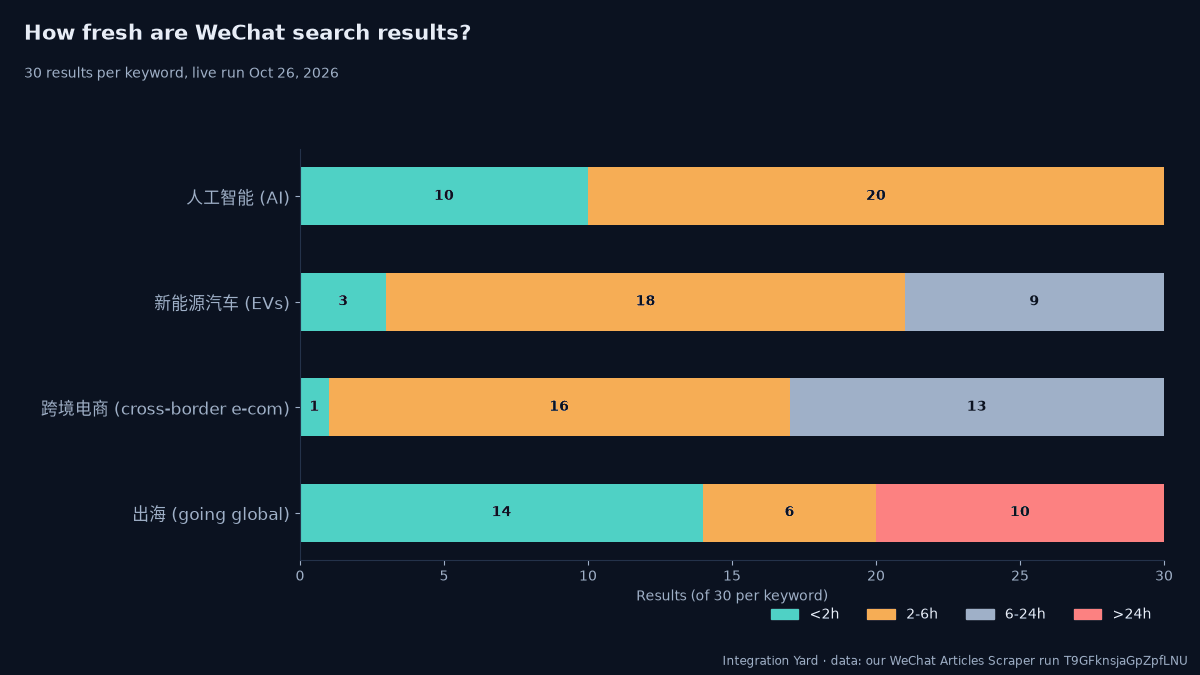
- 人工智能: all 30 articles were published in the 4.3 hours before the run. 10 were under 2 hours old.
- 新能源汽车: all 30 were under 9 hours old.
- 跨境电商: all 30 were under 14 hours old.
- 出海: 20 of 30 were under 6 hours old. The other 10 were much older; more on that below.
Our run started at about 1 AM Beijing time. Most of the newest articles were published between 7 PM and midnight Beijing time, which matches how many Official Accounts push their daily post in the evening.
What this means in practice: a daily scheduled run on a handful of keywords gives you a near real-time feed of what Chinese media and industry accounts are saying about your topic. You do not need to search the archive to get value.
Evergreen results and why a date filter matters
Broad, long-running keywords behave differently. For 出海 ("going overseas"), the first page of results was dominated by well-known analysis pieces from major outlets, some of them several years old:
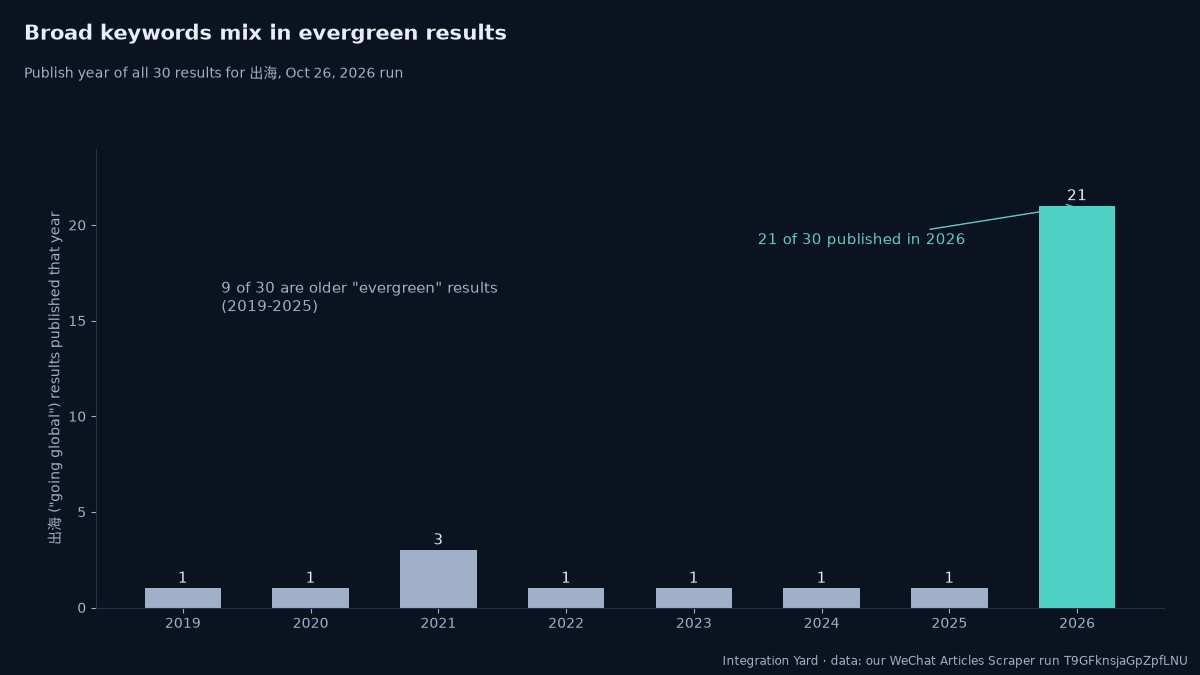
- 21 of 30 were from 2026, and 20 of those were published within the previous six hours.
- 9 of 30 were from 2019 to 2025, including pieces from 36氪, 虎嗅 and 南方周末. Together with one from March 2026, that makes 10 results more than a day old.
- The oldest was a Dec 2019 36氪 article asking whether Li Ziqi (李子柒) had really "gone global".
That mix is useful if you want the classic background reading on a topic. It is not useful if you are building a daily monitor, because you would pay for the same old articles again and again.
That is what publishedAfter is for. Set it to yesterday's date and those ten older rows are skipped and not billed. Combined with accountFilter, you can build a feed like "everything 36氪 and 虎嗅 published about 出海 since Monday" in one run.
How many different accounts you reach
The second question was breadth: does a keyword search keep returning the same few big accounts, or does it reach the long tail?
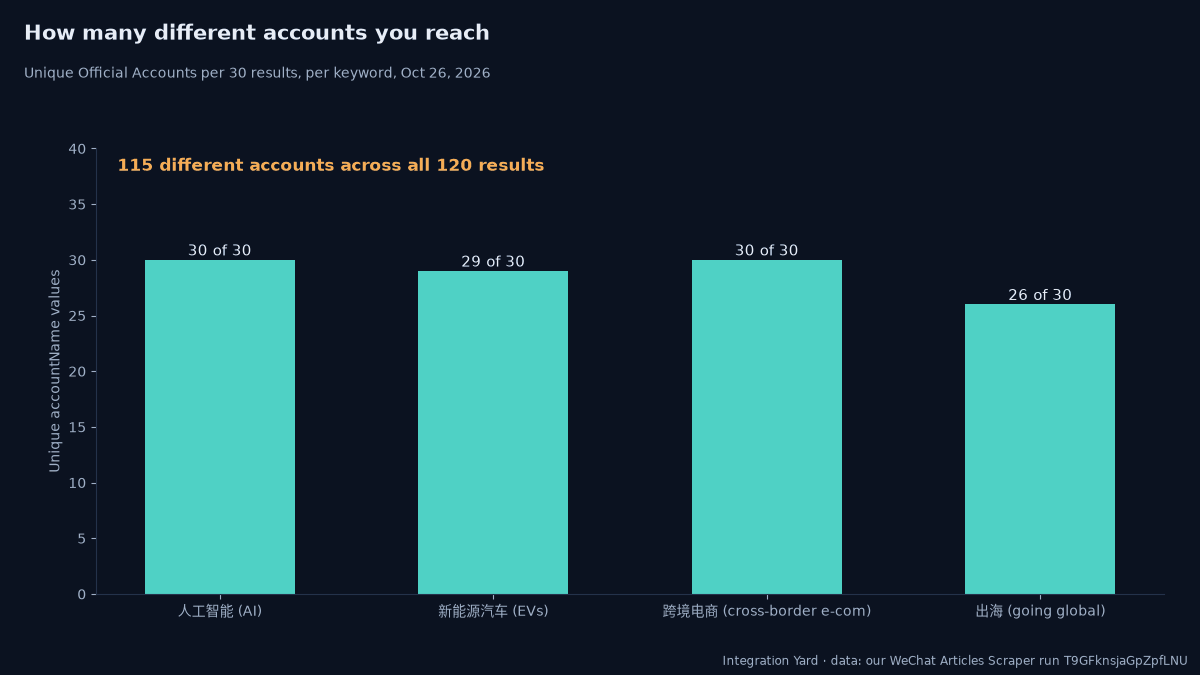
It reaches the long tail. Across the 120 results, we saw 115 different accounts. Per keyword:
- 人工智能: 30 accounts for 30 articles, from 华为中国政企业务 (Huawei's enterprise arm) to think tanks and universities.
- 跨境电商: 30 accounts for 30 articles, mostly sellers' advisers, tax and compliance firms, and industry parks.
- 新能源汽车: 29 accounts.
- 出海: 26 accounts, with 36氪 (3), 虎嗅 (2) and 南方周末 (2) showing up more than once because of the evergreen pieces.
For coverage monitoring this matters. Chinese conversation about a product or a policy rarely happens in five big outlets. It happens across thousands of small accounts run by consultants, local governments, trade groups and individual operators. A keyword search surfaces those accounts, and the account name on every row lets you build your own list of sources worth following.
Full articles: text, images and account IDs
Search rows tell you what exists. Full articles tell you what it says. We turned on fetchFullArticle for 12 results on 跨境电商:
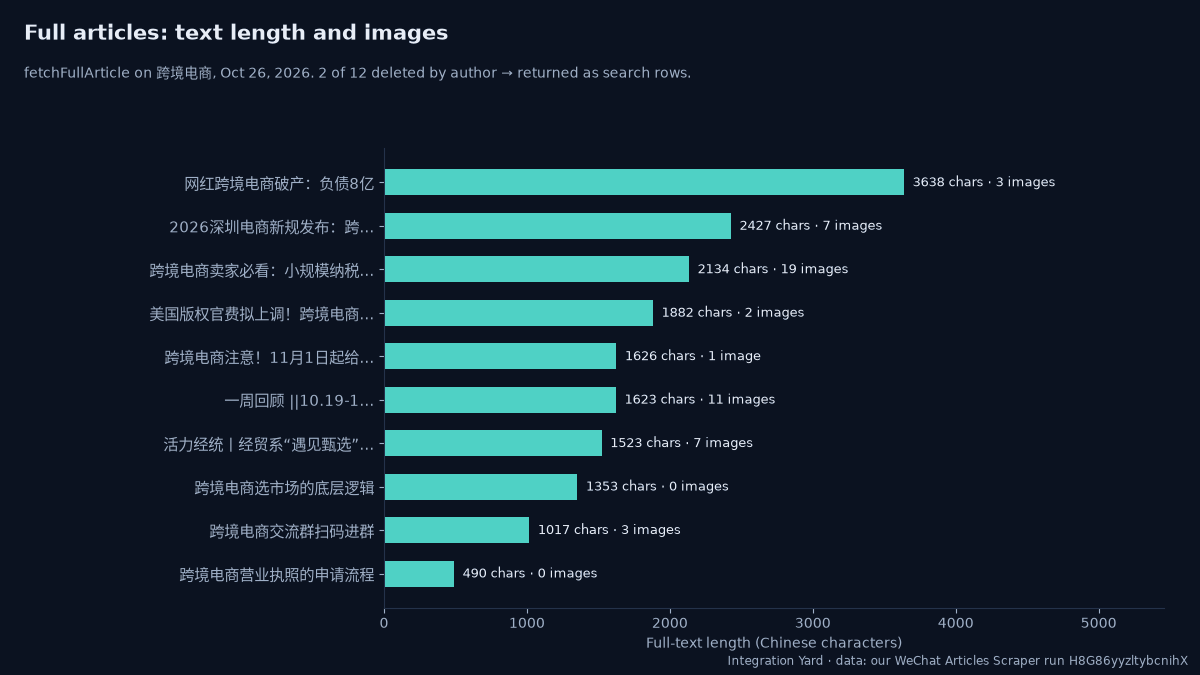
- 10 of 12 came back as full articles. The other 2 had been deleted by their authors between being indexed and being opened. Those were returned as search rows with a
contentErrornote and billed at the search price, not the full-article price. - Article length ranged from 490 to 3,638 Chinese characters, with a median of 1,625. That is roughly a 1,000-word English article.
- The 10 articles carried 53 images in total (up to 19 in one tax guide).
- Every full article had its account ID (gh_…). Five had a public WeChat ID, six named an author, and three were marked as original content (原创).
The topics were what you would hope to find if you sell into this market: new Shenzhen e-commerce rules, Q3–Q4 tax back-payment guides for Amazon and Temu sellers, a weekly roundup of industry changes, US copyright fee changes for sellers, and a case study of a cross-border seller that went bankrupt with 800 million yuan of debt. That is a week of market intelligence from one small run.
Here is how a search row compares with a full article:
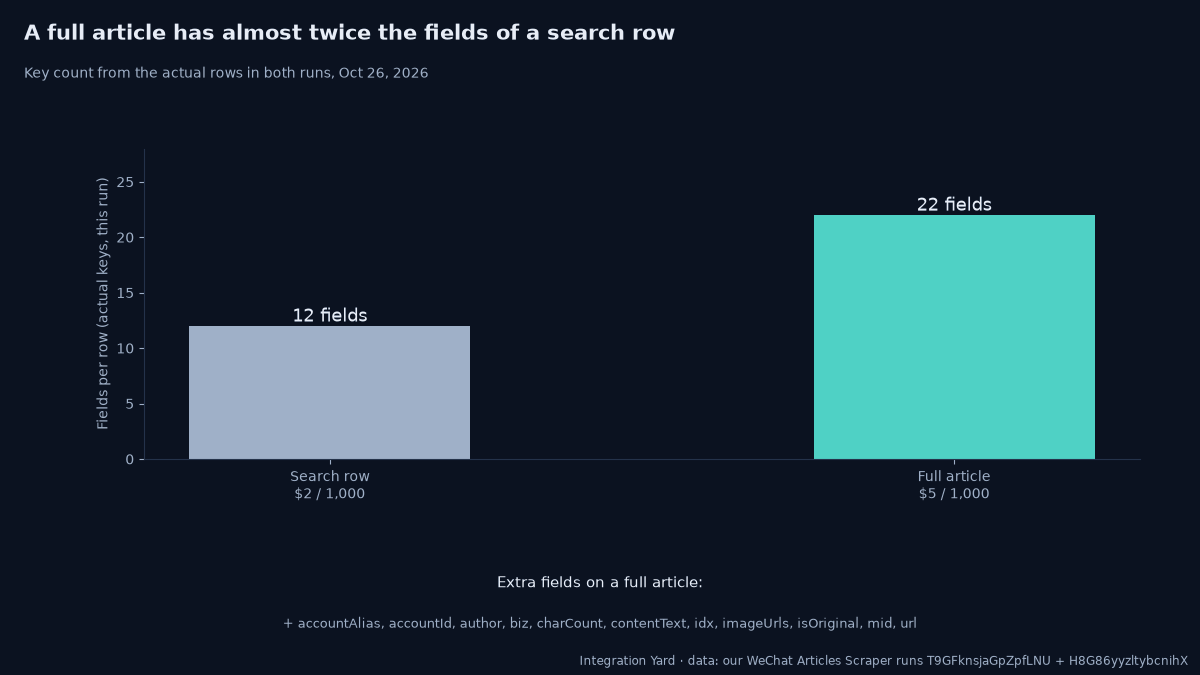
A search row has 12 fields. A full article has 22, including the full text, image list, author, account ID, original-content flag and stable article identifiers that help you deduplicate across runs.
What it costs
Pricing is pay-per-result. You pay for rows you receive, and nothing for rows a filter skips.
| What | Listed price | Our test |
|---|---|---|
| Search result | $0.002 each ($2 per 1,000) | 120 rows ≈ $0.24 |
| Full article | $0.005 each ($5 per 1,000) | 10 full + 2 search rows ≈ $0.055 |
| Run start | $0.001 per run | included above |
Higher Apify plans get an automatic discount on the main result events (Bronze 5%, Silver 10%, Gold 15%). Apify's free plan includes monthly platform credit, so a test like ours costs nothing out of pocket for most new users. A maxChargeUsd cap (default $5) stops any run before it goes over your budget.
A realistic daily monitor of 10 keywords with 30 results each, filtered to the last day, is at most 300 search rows a day, so about $0.60 a day or $18 a month. Turning on full text for, say, the 50 most relevant articles a day adds at most about $0.25 a day.
Ready to run those numbers yourself? Try the WeChat Articles Scraper — Apify's free plan includes monthly platform credit, so a test run like the one in this guide costs nothing out of pocket for most new users.
Five things people use this data for
- Brand and competitor monitoring. Track your brand name, your competitors' names and your product category in Chinese. Get a daily list of who wrote about them, with the account name and a summary, and open the full text only when it matters.
- Market and policy research. Keywords like 跨境电商, 出海 or a specific regulation surface the explainers that operators actually read: tax changes, new rules, compliance guides. In our sample, half the cross-border articles were about tax or regulation.
- Investment and sector tracking. Investors following Chinese EVs, AI or consumer brands can watch how often a company or theme is discussed, and by whom, before it reaches English-language media.
- Source discovery. Because a search reaches the long tail (115 accounts in 120 results), it is a fast way to find the specialist accounts in a niche, then follow them with
accountFilter. - Chinese-language datasets for AI. Full articles give clean, long-form, current Chinese text with titles, dates and authors attached, which is useful for summarization, classification, RAG and evaluation sets.
Limits, ethics and data protection
- About 100 results per keyword. Public search without login shows up to about 100 results per keyword. Use several related keywords to go wider.
- Search is keyword-based. You cannot list every article an account has ever published without login. Use keywords plus
accountFilterto follow specific accounts. - Deleted articles. Authors sometimes delete posts. In our sample that was 2 of 12. Those come back as search rows, flagged, at the lower price.
- Public data only. The actor reads only publicly visible articles. It does not log in, does not touch private chats or Moments, and does not need your WeChat account.
- Personal data. Author names and account names can be personal data under GDPR or China's PIPL. Collect what you need, store it securely and have a lawful basis for processing.
- Copyright. Article text belongs to its authors. Analysis, monitoring and research are common uses; republishing full articles is not something you should do without permission.
- Be polite. Runs are paced by default. Collect what you need rather than everything.
FAQ
Is there an official WeChat API for searching Official Account articles? No. The official WeChat developer platform lets you manage your own Official Account, but it does not offer public search across other accounts. Sogou's WeChat search is the public route.
Do I need a WeChat account, a Chinese phone number or a login? No. Everything in this guide works without any WeChat account or login.
How fresh is the data?
In our Oct 26, 2026 test, every result for three industry keywords was under 14 hours old, and all 30 results for 人工智能 were under 4.3 hours old. Broad keywords can mix in older pieces, which publishedAfter filters out.
Can I get the full article text?
Yes. Set fetchFullArticle: true to get the full text, images, author and account ID for each result. If you already have article links, use article mode.
Can I monitor specific accounts like 36氪 or 澎湃新闻?
Yes, by keyword plus accountFilter. Only articles from the accounts you list are kept and billed.
How many results can I get? About 100 per keyword without login. Several related keywords per run is the normal way to collect more.
What does it cost? $2 per 1,000 search results or $5 per 1,000 full articles, plus $0.001 per run, with automatic discounts on higher Apify plans.
What formats can I export? JSON, CSV, Excel or XML, via the Apify API, or into Google Sheets, Make, Zapier and n8n through Apify integrations.
Can I use it from Python or an AI agent? Yes. Any Apify actor can be called from the Apify API, the Python and JavaScript clients, or Apify's MCP server for AI agents.
Why use a WeChat official account scraper instead of writing my own 爬虫 (crawler)? You can write one — Sogou's public search page is open to anyone, and some open-source WeChat crawler scripts exist for exactly this. The trade-off is upkeep: public search pages change their markup from time to time, so a script that works today can quietly break later, and someone has to notice and fix it. A maintained scraper does the same job plus export formats, date and account filters, and pay-per-result pricing, without that upkeep landing on you.
Is it legal to scrape WeChat articles? The actor collects publicly visible articles only. Check the rules in your jurisdiction and for your use case, and follow the data protection and copyright notes above.
Try it
- WeChat Articles Scraper on Apify Store: the form opens with 人工智能 prefilled. Press Start for a 30-row sample (the default).
- Add
publishedAfterand a few keywords, then schedule it daily for a monitoring feed. - More China data: Weibo hot search guide, Douban reviews guide, and Weibo and Bilibili guide.